Showing posts with label horror. Show all posts

Wednesday, May 25, 2022

May Media Roundup & Conference Updates

I had a busy few weeks, with Pikes Peak Writers Conference at the end of April and StokerCon two weeks later. Funnily, I was anxious about attending each, though for different reasons, but both went well, and I had a lot of fun. Those of you who also suffer from fibromyalgia and/or chronic fatigue syndrome know well what I'm going through after attending two conferences back to back, but I'm glad I went.

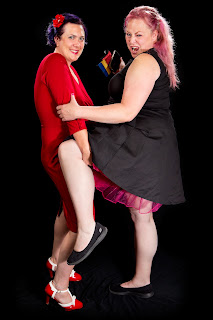
I already posted a bit of a recap of PPWC in my May IWSG post, but I didn't post pictures, so figured I'd share some of those here. Our long-time photographer, and the person who did my headshots, which I still use, Jared Hagan, did a fun photo studio for the Saturday dinner, which was prom-themed. I chose not to go prommy, but I did dress up. 

Me with a couple friends: MB and Kim

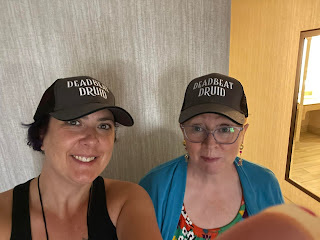
MB and I pimping a friend's book (David R. Slayton, Deadbeat Druid)

Hiding in my room to get some downtime

With friends Charise and Pete

With friends (and now my publisher) Sam and MB

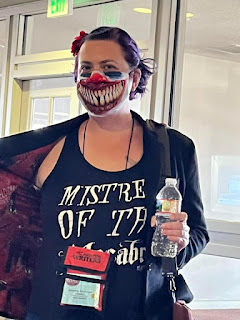
Friday horror clothes for a Friday horror workshop (look closely at the jacket lining--I'm not flashing you just for fun)

Me psyching myself up to do my last workshop of the weekend (number five) before folks showed up

Kameron and I in a goofy pose


StokerCon only lasted two days for me. Since I had a reading Thursday night, a panel Friday morning (EARLY), and then the book signing Friday night, I switched my hotel nights to Thursday and Friday, and headed home Saturday. By that time, I was also incredibly sick with vertigo, because I had to use the elevator, as the hotel had the stairwells locked from the inside to keep homeless folks out of the hotel. The hotel, The Curtis, was in the middle of downtown, or what's referred to as LoDo--Lower Downtown. I try not to take elevators when I can help it, which, yes, has meant using the stairs in some insanely tall buildings. For SC, I was on the 16th floor, in a beautiful corner room with a view of the city. I learned the stairwell doors were locked AFTER descending from the 16th floor to the second floor and having to climb back up, trying doors as I went, until I found an unlocked door on the tenth floor. 

My reading went well, with a nice turnout, including several friends. We walked a few blocks to grab dinner afterward, then went to a social with an open bar. There, I made a point of introducing myself to some folks I've only "met" on Facebook before. Everyone was very friendly. Then I went to a fun panel that was split into two teams. Each team was given a famous horror villain and had to make their case for why their villain would beat the other villain. Then a panel of three judges decided who had won. It was a lot of fun, and there were some major horror authors all together on one panel.
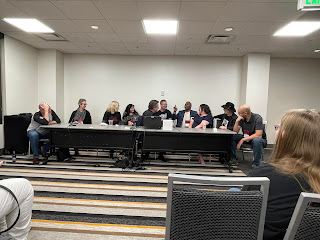
Monster Mash panel, with Brian Keene, Jennifer McMahon, Nancy Holder, Sephera Giron, Jeff Strand, Marc Abbott, John Skipp, (and some folks whose names are not popping up in my head right now...sorry!)


The next day, I got up super early and waited at the elevator. And waited. And waited. When you're on the 16th floor during a busy convention, the elevator comes to you quite sparingly, as it turns out. Of course, I normally would have just TAKEN THE STAIRS. Since I couldn't, I was late to my one and only panel, which I wasn't happy about, but I couldn't do anything about it at that point. The panel was about podcasts, audiobooks, and audio adaptations, and the room was packed. My fellow panelists were Wendy Wagner, Tonia Ransom, James Sabata, Alex Hofelich, and the moderator was Marc Abbott. They were a great group, and no one gave me crap for being late, which was nice.

The signing was insane. There were so many people crammed into the room. I don't think I've ever been in a busier signing before, and I've been in plenty. I sold a few books, and some more folks bought them online. I was lucky to be seated near some folks I knew.

Random funny story: a previous editor and current friend had asked if she could ship a couple contributor copies to me, so I could hand them off to two authors, one coming from New Zealand, one from Australia. (And I got a free copy for my troubles!). We were in touch via Messenger and text, trying to set up a meeting time. Well, you know that morning I was late to my panel? When I was stuck waiting for the elevator, a couple from New Zealand showed up, as well, and we waited together. We even introduced each other while standing there. Then I'm sitting at the Denver Horror Collective table later and it hits me that the Lee I was meeting with was the very same Lee I'd been standing at the elevator with, which I confirmed later. I did successfully get them their books, and both women ended up winning Stokers on Saturday evening! Not only that, but after chatting and trying to arrange meeting up to give them the books, we ended up at signing tables right next to each other. The world's a small place, don't you think?
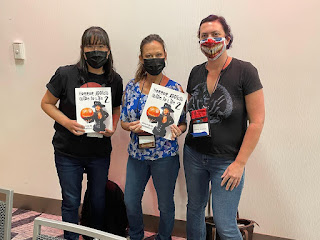
With Lee and Gene at the signing, books handed off!

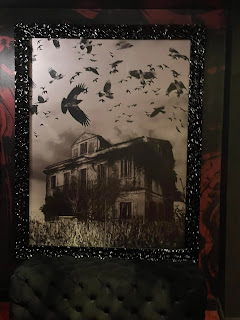
Before I jump into this month's media, which is pretty sparse since I was doing a lot of prep for conferences, I'll leave you with some pictures of the 13th floor of the Curtis, which is horror-themed. In fact, each floor was themed, and I believe there were themed rooms, as well. 

Down one hallway, the girl from Poltergeist

The wallpaper!

On the wall by the elevators

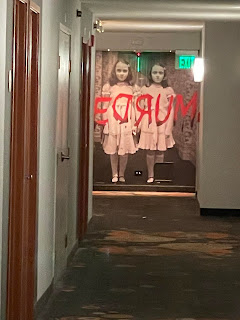
The Grady twins from The Shining down another hallway

Okay, media! These are some of the media I enjoyed in May and late April.

Books 


60 Ways to Die in South America, by Tracy Ashworth


A silly romance with adventure and humorous foibles. A journalist gets sent to South America to cover adventurous travel, something she is definitely not suited for, but money talks. The photographer sent to work with her knows what he's doing, and spends a lot of time saving her from herself on their adventure spree across South America. 

I can sometimes be irritated by the type of main character in these books, because they're a little too stupid for my liking and are frequently constant victims, but I felt like this character held her own a bit better than usual. The romance is sweet and the situation was a unique one.

How Beautiful We Were, by Imbolo Mbue


This book is gorgeous, soulful, and heartbreaking. It traces the line of a family in a small, African village, as they deal with the trouble western civilization (mainly Americans) and their own government and people bring to bear. From people kidnapped as slaves to oil companies destroying the land and the people who must live on it. 

The story is told from different points-of-view, including a collective group called "The Children." It is fascinating how well Mbue weaved their stories together so that there was nothing whatsoever awkward about a group of people speaking as one in those chapters. It's hard for me to explain, but I feel writers should read this for that mechanism alone.

The standout character is Thula, a young woman who starts out as a child at the beginning (her age-mates are "The Children"), watching first her father and then her uncle be destroyed by His Excellency to keep the villagers quiet. But she gets an opportunity to travel to the U.S. and attend a college there. She learns how to fight back for civil rights, and brings her knowledge back to help those villagers still remaining. Her determination makes you want to believe she can overcome her powerful government; the bad decisions of her age-mates, fellow villagers, and patriarchal countrymen; and  and the legal power of an American oil company. Her passion is contagious.

Not a fast read, but definitely worthwhile. Stunning.

Movies


The Lost City


I was all in as soon as I saw Sandra Bullock and a preview that told me this was deeply inspired by Romancing the Stone. It very similar to RtS, but updated, with some important changes. Bullock is always funny, and Radcliffe makes for a great villain. Entertaining, funny, and action packed.

Ritual (Shudder)


This Indonesian horror film was horrifying, but then it threw a bizarre twist that made it all that much more horrifying. The twist is well done, the dread palpable, and the horror...well, horrifying. A man wakes up buried under a pile of dirt. He must find his way to safety and try to find his family, who are also being hunted in the woods. And that's all I can say without giving anything away. Seriously, though, this one will stick with me, both for the abject horror of what came before the twist and the dread that followed it.

Senior Year (Netflix)


This could have failed hard and been stupid, but it was both funny and full of heart. A popular senior gets knocked out during a cheerleading exhibition, going into a coma for twenty years. When she wakes up, she's stuck with the mentality of a senior in high school, even though her body is twenty years older. Determined to get prom queen, which she was destined for before her coma, she goes back to school to finish her senior year and get popular all over again.

Jamie Marks is Dead (Shudder)


A fairly quiet film that follows the death of a boy. A different take on the afterlife and the undead. There's little violence and no real gore.

A fellow student happens across the dead body of Jamie Marks by the river. Jamie was bullied while alive, yet people now come out to grieve his death. But when the girl who found him and a boy who never bullied him start seeing Jamie walking around as if he were living, they each handle it differently.

TV Shows


LOL: Last One Laughing - Canada (Amazon)


A group of well known comedians is locked in a room, armed with humor and plenty of props. The last one to laugh wins. 

Hysterical. I guarantee you're going to recognize some of these comedians. Hosted by Jay Baruchel, you'll have a whole new appreciation for comedians after watching this. Absolutely addictive. I also recommend the Australian version, hosted by Rebel Wilson. There are a ton in other countries, including Germany and Mexico, but I haven't tried watching them yet. Not sure how well humor translates with subtitles. I'm hoping they'll do a U.S. one soon, but if not, I'll be happy with new seasons of Australia and Canada.

Dirk Gently's Holistic Detective Agency (Hulu) (originally BBC America)


This show is so weird! But incredibly twisty and entertaining. Elijah Wood plays a bit of a sad sack, who works at a hotel and gets sucked into the maelstrom that is Dirk Gently, a detective who is constantly mixed up in bizarre things, such as a the mind of a teenage girl being put into a dog, and vice versa. There's time travel, action, danger, and more. And so. much. weirdness.

The Baby (HBO)


This horror comedy is only four episodes in, but it's made a splash, so far. An unlucky woman who has retreated to a private house on the beach at the base of a sheer cliff happens to be having a smoke outside when, first, a woman plummets to her death right in front of her, and then a baby falls into her arms. 

It turns out that everywhere the baby goes, horrible things happen to people. Deadly things. While the first three episodes were darkly comical, the fourth episode had me seething in rage, so maybe a little too relevant to current affairs. I'm looking forward to the return to dark comedy next week. The serious episode was a bit of an origin story.

Hacks


I've only just started then, so I'm two episodes in, but it's a good one. Jean Smart is a famous enough comedian to have a nightly show in Vegas and a ridiculously oversized mansion in the desert. A "cancelled" comedian ends up writing for her, and the show is about their relationship.

I love Jean Smart, and have since "Designing Women," though I much prefer her in her savvier roles. She's in full savvy Jean Smart mode in this one. There are some funny elements and some dramatic elements, and it makes for a good watch.

What have you been watching? Any good shows, movies, or books you'd recommend? Attended any conferences or conventions lately?

May you find your Muse.


Wednesday, March 30, 2022

A Flower in My Hair - Reflections on Genre Bias

It's one of those weeks again, where there's been an attack on horror authors via social media, implying we're all psychopaths and terrible people. Happily, I've never had someone tell me to my face that they believe this about me, but on the wider spectrum it can be hurtful to hear this repeatedly.

Angry Eyes, by OCAL, clker.com

The good thing is, I can fall back on my communities, those of the blogging world and of the authors here in Colorado who I've gotten to know, and I can remind myself that there are plenty of people who know that being involved in the horror world doesn't make someone a bad person, just a creative person whose creativity has a dark bent sometimes. I also write humor, mystery, memoir, fantasy, and science fiction, and no one has judged me based on those things.

It makes me think of the abuse those in the romance genre also get. The insinuations and side-eyes they receive, because they MUST be smutty people, right? No, of course not. Or how about when a literary writer looks down at genre writers as writing junk or when the opposite happens and a genre writer dismisses a literary writer as being snooty?

We writers know that writing something doesn't mean we've done it, that we want to do it, or anything along those lines. I'm not even sure, though, if this current attack that blew up on Twitter came from a writer or a reader, but I've seen plenty of writers generalize those in other genres, and even in their own genres. After all, we do this all the time about ourselves. Stereotypes exist for a reason. Sometimes we amuse ourselves by playing around with stereotypes. For example, that guy at the bar who laughingly downs his fifth beer and says it's okay, because he's Irish. Or what about all the stereotypes surrounding something as basic and unchangeable (except with dye) as hair color? I bet if I asked you to list a bunch of hair color stereotypes you could bang them out, no problem. You may have even joked about your own hair color before. 

The Beer Snob, by OCAL, clker.com

As writers, I think we often employ stereotypes or generalities in our writing, especially in the beginning before we learn to outgrow those bottled characters, settings, or situations. In some ways, it's a necessity, as it's a comfort level for a reader to find familiarity, and one way to achieve that is through generalizing and using commonalities or things we've observed regularly. When there's a story about a group of people, chances are at least some of those characters will fall under some sort of stereotype, like the fiery, short woman or the "Karen" asking to see the manager. Part of writing is pulling the reader in as soon as possible, so if we sat back and looked at the ways we do that, we might find we're generalizing or stereotyping more than we even realized it.

However, I mourn for the days where I didn't hesitate before answering every time someone asked me what I wrote. Now I lob it like a softball and wait for a reaction before I say anything else about it. The two responses I'm most likely to get are either "Oh, I love horror! What have you published?" or "Oh, I don't read that stuff." Sometimes I get a really puzzled or semi-disgusted look and a, "But you're so pretty," as if somehow not looking like a hideous beast means I can't possibly be a horror author. That one cracks me up, and I can usually spin it into something positive.

Hey, to each their own. I don't hold it against anyone if they don't read horror. I admit that sometimes I get tired of hearing it, especially when it's thrown out like a shield or as if they feel they have to state it lest they be judged as a horrible person. I don't respond to someone who writes a genre I don't read with, "Oh, I don't read that," even if I don't or it's rare that I do. I don't hate any genre that I can think of. And I certainly don't think ill of anyone writing any particular genre. I prefer to continue asking them questions about their stories and their love of their preferred genre, so I'm supporting them instead of making them feel defensive or shutting them down. After all, we're all spinning tales and creating worlds and situations, which means there's always something worthwhile to talk about. Even someone writing memoir or other nonfiction is actively creating, whittling down the many details that surround real life, then weaving the remaining threads into a story people want to read.

Things were more fun when I didn't fear people's reactions to me doing something I love. When I didn't have to wait out whether that person might end the conversation with me or get that look of disgust before they realized it and brought it under control. When they didn't eyeball me as if looking for a knife hidden behind my back or horns peeping out from beneath my hair. I'm well aware that I shouldn't care what others think of me. I'm a middle-aged woman, after all, and no matter what I've done as a serial people pleaser, I'm certain I've left behind plenty of people who simply didn't like me.

But those who do like horror, and those who simply respect that it's something I enjoy, and that it doesn't make me a bad person, make it worth it. Because ultimately writers DO support writers. There are bad eggs, but they're greatly outnumbered, and I truly believe that most writers don't judge each other based on the genre they write, and are just intrigued as to the worlds their counterparts create. I know it's that way for me. I want to know about your stories. I want to know what inspires you. 

Photo with my "thank you" mug from Sisters in Crime after a recent workshop I did for them. Note the flower in my hair and the suit jacket.

So I put a flower in my hair to signal that I'm harmless, dress professionally at writing events so they know I'm a normal person, and throw out that softball to wait it out and see where the conversation will go afterward.

If you've ever had a knee jerk reaction about a genre someone writes, I'd love to challenge you to read a story in that genre and to go one step further: write a piece of flash fiction or a short story in that genre and see how you feel about it then.

Do you have a genre you have a knee jerk reaction to? Is it one you've experienced or is it one you've always avoided? Have you ever challenged yourself to try out a genre you weren't fully comfortable with? What happened with that?

May you find your Muse.

Wednesday, September 29, 2021

Horror List Book Review: Slaughterhouse Five

Remember this? I'm slowly, but surely, getting back to my old routines. Now that I'm done with school, I can get back to the best horror list!

I'm reading through three lists of best horror with two friends (DeAnna Knippling andM.B. Partlow), posting reviews as we go. (For more information, including a list of the books, see this post.) To see the books I've reviewed so far, you can view the list at the end of this post where I rank them.

This week I'm reviewing Slaughterhouse Five, by Kurt Vonnegut.


This is my first time reading a book by Vonnegut, and I may be hooked. His prose is quick and almost rhythmic sometimes. Fluid. There are quotable bits ("How nice--to feel nothing, and still get full credit for being alive.") and other impactful parts that aren't as quotable. 

In this book, we follow a character named Billy Pilgrim, a soldier in WWII who was present at the bombing of Dresden. The memories/scenes shared show the uselessness, hopelessness, and ineffectualness of war. There are no great battle scenes in this one. Instead, there are lost soldiers and quick captures.

The narrative jumps back and forth in time, ostensibly because Billy has become disconnected from himself and jumps to different time periods. At some point, he was kidnaped by aliens, or so he relates, much to his daughter's chagrin. The reader never knows where they'll be next, or what might cause the leap. 

A satire on war, there are comic moments, but also deeply horrifying moments that are intentionally thrown out in a lackluster way. The words "so it goes" punctuate many of these moments.

The horror in this lies in the psychological aspects of war and what humans do to each other. Understated and almost comical at times, the horror is still there.

I'm glad I finally read this one after decades of hearing about it. It's definitely a lesson in writing horror that doesn't look like horror on the outside.

Have you read Vonnegut? What's your favorite book by him? Have you read this one? What did you think?

May you find your Muse.

Wednesday, May 24, 2017

Epiphanies From Deconstruction - Horror

I did a workshop for Rocky Mountain Fiction Writers recently that made me look at how I thought of horror and reanalyze it in an attempt to help others understand it more. As I've delved deeper into the genre, I've expanded my own definition of it. Problem being, I see the same original, narrow view that I've left behind reflected in others' views on horror.

I frequently get comments like "I don't read/watch horror" or "I don't enjoy horror." But then there will be an exception to that. For example, "I don't enjoy horror, but I really liked Coraline/The Handmaid's Tale/Hunger Games/Stepford Wives/Planet of the Apes/Flowers in the Attic," etc. Right now, some of you are reading this and saying "Stepford Wives wasn't horror." Wasn't it? If Get Out is horror, Stepford Wives is, as well. Both look at subjugation and internal, unconscious biases in a frightening way that puts others in harm of losing themselves.


We've pigeonholed horror by defining it by one aspect, and each of us has a different aspect we define it by. Some might think horror is all slashers and gore. Some think it has to involve a monster. Sadly, even known authors of horror deny writing it, because they fear turning off readers and limiting their audience.

Interestingly, the Horror Writers Association pinpoints when this narrowing of the genre definition occurred: the 80s. And they blame it on one specific work: Stephen King's Carrie.


You see, horror wasn't a genre until sometime in the 80s. Even now, it's just a subgenre of fantasy, technically, but then we've split fantasy out into subgenres like dark fantasy and urban fantasy, as well, both of which can contain elements of horror.

The real trouble began when the publishing industry started trying to pinpoint the formula that made Carrie such a big hit. They then tried to duplicate that success by seeking similar stories. Suddenly, literature that met the definition of horror was pushed to the side, targeting this very specific form of horror to make sales and get movies made.

If you want to read more about this, put much better than I can, go to the HWA site.

A second problem we writers, specifically, have is that we're taught to pigeonhole our own writing to sell it. Pick a genre. You can't put "historical romantic mystery with speculative elements" in a query letter; you have to narrow that down. Where is it most likely to be put on a shelf? Well, with true horror, in the widest definition possible, it can go on many shelves.

Where would you find The Lovely Bones? Not in horror. Not even in fantasy, even though there are speculative, even supernatural, elements. It's a touching story, but it's also horrifying. There is clearly dread and horror brought out in the reader. What is NOT horrific about a little girl being raped and murdered then forced to watch from beyond the grave as her killer and family become involved in an intricate dance full of risk?


Where would you find The Hunger Games? Not under horror. It's a YA dystopian. But guess what dystopians are? A form of horror. Again, I ask you what is not horrific about children rounded up and forced to fight to the death for the entertainment of the wealthy?

Horror, in its purest form, exists to elicit darker emotions from its readers. That does not always have to be fear, though that's a strong thread, and is frequently present. It can be despair, horror, alarm, terror, disgust. It can be existential dread. It can be unfulfilled hope, brought to a crushing end. It can make you question society, your neighbor, or even your own morals. What it does not have to do is make you fear the creature under your bed (though it's completely legitimate if it does so).

What you'll often find in horror is that the things that scare you aren't the monsters, even when they exist. In The Shining, the ghosts are the least frightening part. The fright factor in The Shining has more to do with Jack's backslide into alcoholism and mental illness. It has to do with the sense of isolation and helplessness his family feels. The horror of a man coming after his wife and child with an ax is far more impactful than a lion shrubbery or a naked ghoul in a bathtub. At our base, we fear those close to us being able to harm us. Even more so, we fear our capacity for violence and wrongdoing. We fear hurting our loved ones, whether by causing physical harm or mental harm.


I realize I won't convince anyone with one short post. But I ask that you think about the wider implications of horror and try looking at things with a slightly different eye. Just because it was not slapped with a label of HORROR, does not mean it does not play in that particular playground. You may truly not like horror, but you may also just not like the narrow definition of horror you've been presented with. Either is legitimate.

Even I, a longtime fan of horror, didn't see it in its full scope. If you've read any of my horror list review posts, you know that I've said about many of the stories that I didn't feel they were horror. Now I know that they were, and that they existed on that list because they impacted someone emotionally in all the right ways. As a result, I'll go forward with a new set of eyes when reading the stories from Nightmare Magazine's Top 100 Horror Books.

Link time. Bear in mind that I'm not endorsing these, merely passing them along. Always do your own due diligence before submitting to a market or contest.

Accepting Submissions:

Cosmic Roots and Eldritch Shores is accepting flash fiction and short stories in the speculative fiction genres (minus horror). Pays $.06/word. Deadline June 28.

The Threepenny Review is accepting short fiction and poetry. Word counts vary per type of submission. Pays $400 for story/article, $200 for poetry. Deadline June 30.

Subprimal is accepting flash fiction and poetry. Up to 750 words. Pays $20. Deadline June 30.

Alban Lake is accepting horror short stories concerning the Ancient Ones for The Mad Visions of al-Hazred. 3000 to 10,000 words. Pays $25. Deadline June 30.

Chicken Soup for the Soul is accepting short pieces for My Crazy Family. Up to 1200 words. Pays $200. Deadline June 30.

Inklings Publishing is accepting short fiction, nonfiction, and poetry for Perceptions: Bullies. This is an anthology for kids. Up to 5000 words. Pays $20. Deadline June 30.

Broken Eye Books is accepting weird fiction set in Miskatonic University. Must involve the Cthulhu mythos. 3000 to 6000 words. Pays $.08/word. Deadline June 30.

Contests:

Helen: A Literary Magazine is holding their Visual Prompt Quarterly Contest. Poetry, fiction, nonfiction, or experimental. There are three images, and it can contain one or all of them. $25 prize. Deadline June 30.

How do you define horror? Have you looked at any of the mentioned stories as horror? Do you find yourself pigeonholing horror into narrow definitions? Are any of these links of interest? Anything to share?

May you find your Muse.

Monday, November 7, 2016

Mile Hi Con Recap - Supernatural, the Undead, & More

It's been a week since Mile Hi Con, so it's high time I do a recap, eh?

MHC was held in Denver Halloween weekend. Kelley Armstrong and John Varley were Guests of Honor, and Chaz Kemp was the Toastmaster. I had a not-so-secret hope that I'd be on a panel with Kelley Armstrong, but alas, it didn't shake out that way. There's always the future!

On Friday, I was on the panel Horror on the Menu: Different Flavors for Different Tastes. I already covered a bit about this panel in this post. My fellow panelists were Sam Knight, Emily Godhand, Amity Green, and C.R. Asay.

Hororr Panel: Sam Knight, Emily Godhand, me, Amity Green, C.R. Asay

We had a great conversation about the different types of horror out there, with a consensus that psychological horror was preferred by most of us, but that there is plenty to enjoy elsewhere. Look these folks up if you're seeking some good horror to read!

I went straight from this panel to being a representative of Pikes Peak Writers and hosting a mixer. We had a solid turnout, and I got to hang out and chat with some familiar faces and lots of new faces, which was wonderful. In order to let our lovely waitress get closed up and go home, we retired up to a party hosted by the folks who run Myths and Legends Con, a convention I hope to check out this coming year. They had finger sandwiches, alcoholic chai, and lots of other goodies. The party was still going when we left in the wee hours.

JT and Jennifer work the Pikes Peak Writers table

Saturday afternoon I had a panel I was incredibly nervous about. You see, the way they handle faculty sign ups is to send out a list of the workshops sans descriptions and have you indicate what workshops you'd be interested in, willing to be in, and adamantly against (basically). This one said F/SF Outside the West. Being a wild west buff, that's the version of the west that came to mind, and I marked it as interested, thinking it was F/SF except for the new fantasy-based westerns that are becoming more popular. (Which is a weird thing to think, looking back, but it's where I went, anyway.)

Instead, it was a panel about non-western writers. As in, writers outside the U.S. and Europe, or whose voices differ from those commonly found in the west. When I discovered later what it was about, I jumped into research, reviewing those voices I'd already experienced and checking out a ton of books from the library. Not an unpleasant experience as a reader! However, I doubted my knowledge in the area, and was terrified I'd be asked a question that would make me look like an idiot. Instead, the conversation was an interesting one, with us discussing why it's important to read non-western voices (to experience different ways of life, to see the similarities between our culture and the culture of others, to learn more about viewpoints and issues facing our non-western counterparts, etc.), what voices to read (I'll list the ones I mentioned, plus some suggested by my co-panelists below), and how to handle writing non-western voices (key takeaway = RESPECT). We discussed that research should be more than reading about the non-western cultures we're representing, and that speaking to people within those cultures and finding beta readers within them is a good idea. And even then, there will be someone who isn't happy with what you took away from it. A good piece of advice given by Amalie Howard was not to be offended if someone calls you on what you've written that they is false, but to ask them to let you know where you went wrong (while also understanding that it's not their job to educate you, and they can refuse if they please.)

I was happy to be able to recommend some of our fellow bloggers, as well as to mention a couple Native American authors (Native American voices do not typically fit into the western niche). Here's a list in case you want to check out some new authors:


Bish Denham (Fantasy, MG) - The Bowl and the Stone
Pam Munos Ryan (Magical Realism) - The Dreamer, Echo, Esperanza Rising
Isabel Allende (Magical Realism, some MG) - City of the Beasts
Cixin Liu (SF) - The Dark Forest
Gabriel Garcia Marquez (Magical Realism) - Of Love and Other Demons)
Amitov Ghosh (Epic Fantasy) - Sea of Poppies
Sofia Samatar (Fantasy) - A Stranger in Olondria
Karen Lord (SF) - The Best of All Possible Worlds
Haruki Murakami (Fantasy/Dystopian) - IQ84
Nnedi Okorafor (Post-Apoc Fantasy) - Who Fears Death, Binti
Damyanti Biswas - short fiction, Forge Literary Magazine, editor
Sherman Alexie – Reservation Blues
Stephen Graham Jones (Horror)- Any
Jeff and Ann Vandermeer - The Big Book of Science Fiction (contains 13 short stories translated into English for the first time)
N.K. Jemisin - The Fifth Season; The Killing Moon
Saladin Ahmed - Throne of the Crescent Moon
Ahmed Khan - A Mosque Among the Stars
Jaymee Goh - The Sea is Ours: Tales from Steampunk Southeast Asia
Kim Stanley Robinson - The Years of Rice and Salt
Jorge Luis Borges - Fictions
Ken Liu - The Grace of Kings
Chitra Banerjee Divakaruni - Mistress of Spices, and other titles
Zaraida Cordova - Labyrinth Lost
Renee Ahdieh - The Warth and the Dawn
Roshani Chokski - The Star Touched Queen
Cindy Pon - Serpentine (Book 1) and Sacrifice (Book 2)
Tracey Baptiste - The Jumbies

My co-panelists on this one were Stant Litore, Amalie Howard, and Jane Bigelow.

There was a book signing a few hours after this, which I could opt to take part in. I went ahead and did so, knowing I probably wouldn't sell any books (I didn't), but it was fun, as I got to sit with Evangeline Denmark and Amity Green. We chatted with each other and had a bunch of people stop by to talk to us, so it was still a good experience. I actually had the option of selling my books at the Pikes Peak Writers table, but since I was hardly ever there, I didn't do so.


My last panel was Re-imagining History With the Living Dead. My fellow panelists were Stant Litore, Aaron Spriggs, and DeAnna Knippling. Both this panel and the SF/F Outside the West panel had no-show panelists, which is why there were only four of us on each of those. I have no idea why the other panelists didn't show (though I have them both on Facebook, so I suppose I could ask them.) This one was different than I'd expected, but lots of fun. The audience gave us time periods in history, and we discussed how it would work for the living and the undead, what the pitfalls might be for either side, what might contribute to it, etc. We went from prehistoric times to Egypt to the Romans to the vikings. It seems like this could be a party game.

I had dinner out with various friends each evening, walking both nights because it was so lovely out. And two of us took a Rocky Horror Picture Show virgin to the sing-along (we didn't out her). I don't believe she was impressed. 


My final act as faculty was to moderate a Supernatural fan forum. This was the second one I was nervous about out of the four I was part of. Reason being, I'd never been to a fan forum, so didn't know how it was actually supposed to run. Also, I don't retain information like true fans do, so I can't pull an encyclopedia's worth of information out of my booty. To prepare, I put together a list of topics on Supernatural, with a good number from the current season. I tried visiting forums online, but didn't find much helpful there, as it's mostly game play and little things that I couldn't make into an in-person discussion. As it was late in the day Sunday, I was afraid no one would show, but we ended up with a full table. Who can resist the Winchester boys?

We discussed favorite characters and episodes (mine is Yellow Fever), whether Cass and Crowley have been neutered, what's going to happen with the mom, monster of the week, and whether the show has run its course (it kinda' has). It was a fun hour of discussion and a much better experience than I expected.

All in all, it was a good experience. I also worked the Pikes Peak Writers information table a few times (though not as much as some others, so thanks to them!), and attended two panels I wasn't in (a dating game-type panel and a podcast panel). The dating game was an interesting concept, and was actually called The Reading Game. Put a reader on one side of a curtain and pull up three authors meeting the desired genre. The reader gets to ask three questions, unaware of who is on the other side. They choose the one that sounds best and get a free book!


My thanks out also to Rose and Patrick, the folks handling faculty and programming. I got to talk a little about one of my first writing loves (horror) and stretch myself out of my comfort zone in speaking on non-western writers and moderating the Supernatural fan forum. Being able to be faculty at conferences and conventions adds a whole new element to the experience, and I definitely enjoy it, even if I stress myself out ahead of time. Connecting with the audience and the other panelists is so much fun, and makes any stress worth it. This con, specifically, is friendly, intimate, and well run. And unlike World Con, I don't leave feeling empty.

Have you read any non-western authors you'd recommend? Any insights? Would you play The Reading Game? What three questions would you ask? What time period would you most like to see re-imagined with the living dead? What's your favorite flavor of horror? Do you think Supernatural has run its course (even if you love it)?

May you find your Muse.

Exposed Brain Zombie by OCAL, clker.com

Monday, October 31, 2016

Let's Talk Horror: A Top Thirteen

It's Halloween! (In case you hadn't noticed.) I've had a busy, stressful, yet also wonderful month, and I haven't gotten to really dive into my favorite time of the year. I thought I should at LEAST talk horror on THE day of all horror days, so here I am.


I was a panelist at MileHiCon in Denver this weekend. It was a blast, though I was insanely nervous about a couple of my panels going in. My comfort level is horror and short stories, but I read [and write] all over the place, so when I was put on a couple panels that didn't directly relate to what I write, I dove in and did some research and a lot of reading (thank you, Pikes Peak Library District, for having so many great books available on your e-shelf!)

I'm not going to talk about the whole weekend now. That will either occur Wednesday or next Monday. But one of my panels was on different flavors of horror, and at the beginning, we were asked what our favorite type of horror was. My answer was two-fold: psychological and horror-comedy. Here's the kicker. Everyone on the panel preferred psychological in some way, shape, or form. No one said, "Gee, I I really dig torture porn." (Yet it sells...) No one said paranormal, either, which I feel is the type of horror we most often cut our teeth on as kids. (Ghost stories with your friends, folks?) Then again, this can cross streams with psychological horror. "The Others," with Nicole Kidman, is an example.

It was also generally agreed upon that people are scarier than monsters. Monsters aren't realistic, but it's acknowledged that people are frightening. Yet favorite books and movies don't always agree with what we consciously feel is the best element. I thought I'd break some favorite movie elements down into bite sized pieces, much like those mini candy bars we give out.

1. Favorite Scene (TIE):

Opening scene from "Ghost Ship." A calm, peaceful evening is interrupted in a shocking and brutal fashion. Mouth = agape.

The elevator scene in "Cabin in the Woods." A single sound ("Ding!") never before foretold such gleeful carnage. I applauded enthusiastically. There may have been joyful giggles involved.

2. Favorite Monologue:

Samuel L. Jackson in "Deep Blue Sea." Monologues should always be cut short by the shocking death of a character you're certain will make it to the end because of who they are.

3. Favorite Halloween-based movie (TIE):

"Halloween" and "Trick r' Treat," of course. One is the original Halloween slasher film; the other is a series of short films revolving around the holiday.

4. Favorite use of a game in a movie:

"The Conjuring." Hide and clap. A harmless children's game used to great effect. "Clap, clap."

5. Favorite Cast:

"Aliens" was ahead of its time, with strong (yet flawed) female characters and a good mix of people of color in the cast. Ripley, our beleaguered survivor; Newt, the bright young girl who survived where the adults couldn't; Corporal Hicks, a soldier, a powerful man, yet willing to hear Ripley out and throw his support behind her; Vasquez, kicking ass and taking names; Apone, a solid leader in a bad, unknown situation.

6. Favorite Final Girl: 

Ripley from the "Alien" series. She was a well written female character, both strong and willing to ask for help. Her story didn't revolve around getting the guy (though I was all for her and Corporal Hicks hooking up). She was flawed, but smart, and calm under pressure.

7. Favorite Fool:

Marty in "Cabin in the Woods." If he'd been the sole survivor, I would have been happy with that. He was the only one who realized something was wrong. Plus, he was comic relief. Without him, there would be no survivor. The stoner with a heart of gold.

8. Favorite Movie Monster:

The xenomorph. When you attack her, her blood sees that you pay. Bug-like, drooling, and creepy, these creatures can skitter along the ceiling as easily as under the floor. The monster that taught me you always look up when you sense something near.

9. Favorite Moment of Lost Hope:

Drew Barrymore's scene in "Scream." The horror of seeing her fight like hell and get so near her parents, only to be gutted as they listen in on the line. This was her return to the movies, and another example of a character I thought was sure to survive, because of who the actor was. The film that taught me that was no longer a solid truth.

10. Favorite Bad Guy You Can't Hate (TIE):

Ginger, of "Gingersnaps." Packed with attitude and snark, pissed off at the excess hair growth, and just wanting to have a little fun, she's impossible to hate as she goes through a whole different kind of puberty.

Hannibal Lecter in "Silence of the Lambs." His mind is sick and twisted, but he fascinates and titillates too much to want him gone.

11. Favorite Movie Quotes:

I have too many to list (believe me, I started), so here's a montage of best movie quotes.

12. Favorite Twist (TIE):

Brad Pitt in "Se7en" finding out he's one of the sinners being punished, and that he's been played the entire time.

"Sixth Sense." Sure, you might have seen it coming, and the little guy tells us right in the beginning that he sees dead people, but there's no way to be sure until we get that confirmation, and suddenly everything makes sense. This was the twist that killed future twists.

13. Favorite Duo:

Val and Earl in "Tremors." Without these two, the movie would just be about giant, killer worms eating people. They are the heart and the comic relief. And also, ultimately, the heroes.

I could have kept listing various favorites, but thirteen seemed like a good stopping point. If none of these catches your fancy, check out "The Exorcist," "Poltergeist," "Hush," "The Shining," "Night of the Living Dead," "Jaws," "Nightmare on Elm Street," "Psycho," "The Fly," "Invasion of the Body Snatchers," "Detention," "A Stranger Calls," "Krampus," or "Re-Animator," depending upon what you're looking for.

Still not good enough? Here's a list of 100 Best Horror Films.

Happy Halloween!

What are some of your favorites? Any favorite categories I should have addressed? Did you disagree on any of them? What type of horror do you prefer?

May you find your Muse.

*Pumpkin from clker.com, Pumpkin2, OCAL

Monday, April 25, 2016

Whirlwind Weekend of Releases

The publishing world is an odd one. Sometimes it moves at the speed of sloth. Sometimes everything hits at once.

I had five publications with unknown or tentative release dates, and I was waiting to hear when they'd be releasing. Well, Saturday I was notified of the release of Once Upon a Scream, an anthology I have a short story in.


My short story is entitled The Black Undeath, and is a new take on the Rumpelstiltskin fairy tale. With zombies.

It can be purchased at Amazon or CreateSpace in paperback for $13.00, but the e-book won't release until May 28.

Horroraddicts.net also did a podcast that involved an interview with Dan Shaurette, the editor, and mentioned something about each of our stories. It's Episode 124. My kids loved hearing my name on a podcast.

If you'll be attending BayCon, those authors from the anthology that could make it will be doing a panel and release party. (I can't make it--sad face.)

The very next day, I received an email that Ember: A Journal of Luminous Things, Volume 2, Issue 2 had released. My creative memoir flash fiction piece, Grandma's Leather Sofa, is in this issue.


This one is kid friendly (one of the very few things I've done that is.) In fact, there are stories in Ember written by kids. And it's fully illustrated! It's on sale for $14.95 at E&GJ Press, but you can use the coupon code SLAWRENCE-FRIENDS to get 35% off!

I actually waited on posting the Ember release, because I didn't want to be obnoxious with the releases on Facebook. But I'll post it today. The kicker is, it looks like one of the magazines I'll have a story in will come out in a week, so boom, boom, boom, three in a row.

Knowing the publishing industry, there will be a gap before the other two release. Funny how that works. Things have been crazy with these two releases and the details surrounding them, and then it will be back to glacier speed, as I wait for acceptances/rejections and release dates.

I enjoy the ride, even if it is sometimes random and stressful.

How was your weekend? Any publishing news to share? Other fun stuff? Have you ever had multiple publications come out at once?

May you find your Muse.

Monday, October 12, 2015

What's Your Favorite Scare?

When you're done here, go visit me at Yolanda Renee's blog, Defending the Pen. I'm giving away a free copy of The Deep Dark Woods, an anthology that includes my short story, The Blue Mist, to one lucky commenter.

***

You know that line from Scream? What's your favorite scary movie? While I'd love to hear that, too, I want to know what your favorite scare is more.


Do you like jump scares? This seems to be the focus of recent horror movies. It does manage to make a person tense when they spend the movie waiting for the jump scare, knowing it's coming. But is that a real scare?


Do you prefer the psychological buildup, where the truth slowly ekes into your brain, building your horror as it registers? No. No, they wouldn't do that. They couldn't do that. Please?


Or are you into torture, pain, blood-letting? Personally, this is my least favorite type of scare.


Does your favorite scare involve monsters? Isolation? The monster within? Do creepy crawlies do it for you every time? Have you ever considered what it is about your favorite scary movie that reaches you deep down?

I did a bit of a mini-workshop (not even that) at a Maker Faire this weekend. My hour was "Ask me how to make anything creepy." In preparation for it, I sat down to analyze what it is that scares people. Sure, clowns, spiders, and slashers scare people, but why? What is it about these different elements that scare people? We may be afraid that something is under our bed, but we all know there isn't really anything under there. So what makes us pull our feet in under the covers.

I broke it down into some basic elements. What is it we actually fear, beyond the surface scares we come up with?

Vulnerability/helplessness/violation of sanctity - No one likes to feel vulnerable, yet horror movies show us when we're most open to attack. They remind us that we're never safe anywhere, not even in the places we feel safest. In the shower (Psycho), in childhood (Poltergeist), when we're sleeping (Nightmare on Elm Street.) The thought of someone in our home, something under the bed or in the closet, is embedded deep within our psyches, because once our home is violated, where else can we go for safety?

Isolation/being trapped/claustrophobia - Something else people fear, even those who love their alone time, is true loneliness and isolation. In space, no one can hear you scream, right? Right. Being trapped on a space ship (Alien) or a ship (Ghost Ship) means there's nowhere to run. And no one is coming to save you any time soon. But you can still be on land and be isolated, such as in a deep, dark cave (The Descent).

Slightly askew/dissonance/humanoid - Our brains have been trained to notice things that are slightly off balance. Even when our conscious mind doesn't notice, our subconscious does. And notice that most of our classic monsters are based on things that are similar to humans or used to be mortal? Vampires (Dracula), werewolves (Silver Bullet), zombies (Night of the Living Dead), even clowns (IT). All of these are one step away from normal people. We fear that which is different, but we especially fear that which is different, yet reflects some element of ourselves back at us. It reminds us of our own mortality, the monsters within ourselves. And it lets us know how close our neighbor or our own selves are to becoming something Other. Even worse is when it is truly human, but there is something that sets it apart (Silence of the Lambs, Halloween). What sets you apart from them? How thin is that line?

The unknown/loss or lack of control - A fear of the dark is really a primitive fear of the unknown that hides away where we can't see it. The thought that something could be right in front of us, yet we can't see it. Something sneaking up on us. This one takes us right back to the caveman days, where the dark held many things that could kill us. Predators that waited until night to find their prey.

Creepy crawlies/nature gone wrong/forces of nature - This one is another primitive fear, born of days in the caves. Snakes and spiders, cockroaches and rats. Each of these things can get into the tiniest cracks, sneak up on us outside or inside. Then they can disappear without a trace (Arachnaphobia), leaving behind the hope that someone can find evidence that it was a spider bite. Or there are the big creatures, the scary things that are just too strong for us (Anaconda, Tremors, Lake Placid, Jaws). Nature is a scary beast. And something we have no choice but to contend with.

Change/science - People fear change, the lack of comfort and the things they know. Yet we deal with change all the time. Stories that deal with this show us dire change (I Am Legend). When it involves science, it shows us that the world can be graphically changed by our own hands. An escaped virus (28 Days Later), artificial intelligence that wants to see us wiped out (Terminator), a mad scientist (Re-Animator).

Pain/torture - The ultimate copout in horror, BUT something that definitely works to reach people. No one likes pain. (Okay not totally true, but most of us don't). We do what we can to avoid pain on a daily basis. The thought of being subjected to intense levels of pain and torture is terrifying (Saw, Hostel).

Of course, most horror depends upon a combination of these elements. I could have moved the movies I mentioned around all over the place, put them in different categories. No horror story depends solely on one type of scare. There needs to be an assault on our psyches to really freak us out.

So. What is your favorite scare? And your favorite scary movie? What tickles your psyche and scares the living daylights out of you? Why? What other categories do you think there are?

May you find your Muse.