Showing posts with label writers conference. Show all posts

Wednesday, May 25, 2022

May Media Roundup & Conference Updates

I had a busy few weeks, with Pikes Peak Writers Conference at the end of April and StokerCon two weeks later. Funnily, I was anxious about attending each, though for different reasons, but both went well, and I had a lot of fun. Those of you who also suffer from fibromyalgia and/or chronic fatigue syndrome know well what I'm going through after attending two conferences back to back, but I'm glad I went.

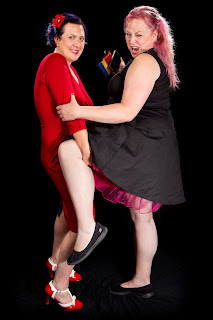
I already posted a bit of a recap of PPWC in my May IWSG post, but I didn't post pictures, so figured I'd share some of those here. Our long-time photographer, and the person who did my headshots, which I still use, Jared Hagan, did a fun photo studio for the Saturday dinner, which was prom-themed. I chose not to go prommy, but I did dress up. 

Me with a couple friends: MB and Kim

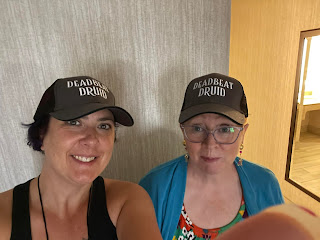
MB and I pimping a friend's book (David R. Slayton, Deadbeat Druid)

Hiding in my room to get some downtime

With friends Charise and Pete

With friends (and now my publisher) Sam and MB

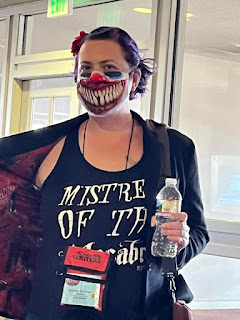
Friday horror clothes for a Friday horror workshop (look closely at the jacket lining--I'm not flashing you just for fun)

Me psyching myself up to do my last workshop of the weekend (number five) before folks showed up

Kameron and I in a goofy pose


StokerCon only lasted two days for me. Since I had a reading Thursday night, a panel Friday morning (EARLY), and then the book signing Friday night, I switched my hotel nights to Thursday and Friday, and headed home Saturday. By that time, I was also incredibly sick with vertigo, because I had to use the elevator, as the hotel had the stairwells locked from the inside to keep homeless folks out of the hotel. The hotel, The Curtis, was in the middle of downtown, or what's referred to as LoDo--Lower Downtown. I try not to take elevators when I can help it, which, yes, has meant using the stairs in some insanely tall buildings. For SC, I was on the 16th floor, in a beautiful corner room with a view of the city. I learned the stairwell doors were locked AFTER descending from the 16th floor to the second floor and having to climb back up, trying doors as I went, until I found an unlocked door on the tenth floor. 

My reading went well, with a nice turnout, including several friends. We walked a few blocks to grab dinner afterward, then went to a social with an open bar. There, I made a point of introducing myself to some folks I've only "met" on Facebook before. Everyone was very friendly. Then I went to a fun panel that was split into two teams. Each team was given a famous horror villain and had to make their case for why their villain would beat the other villain. Then a panel of three judges decided who had won. It was a lot of fun, and there were some major horror authors all together on one panel.
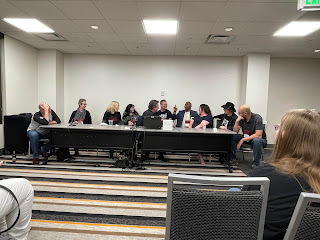
Monster Mash panel, with Brian Keene, Jennifer McMahon, Nancy Holder, Sephera Giron, Jeff Strand, Marc Abbott, John Skipp, (and some folks whose names are not popping up in my head right now...sorry!)


The next day, I got up super early and waited at the elevator. And waited. And waited. When you're on the 16th floor during a busy convention, the elevator comes to you quite sparingly, as it turns out. Of course, I normally would have just TAKEN THE STAIRS. Since I couldn't, I was late to my one and only panel, which I wasn't happy about, but I couldn't do anything about it at that point. The panel was about podcasts, audiobooks, and audio adaptations, and the room was packed. My fellow panelists were Wendy Wagner, Tonia Ransom, James Sabata, Alex Hofelich, and the moderator was Marc Abbott. They were a great group, and no one gave me crap for being late, which was nice.

The signing was insane. There were so many people crammed into the room. I don't think I've ever been in a busier signing before, and I've been in plenty. I sold a few books, and some more folks bought them online. I was lucky to be seated near some folks I knew.

Random funny story: a previous editor and current friend had asked if she could ship a couple contributor copies to me, so I could hand them off to two authors, one coming from New Zealand, one from Australia. (And I got a free copy for my troubles!). We were in touch via Messenger and text, trying to set up a meeting time. Well, you know that morning I was late to my panel? When I was stuck waiting for the elevator, a couple from New Zealand showed up, as well, and we waited together. We even introduced each other while standing there. Then I'm sitting at the Denver Horror Collective table later and it hits me that the Lee I was meeting with was the very same Lee I'd been standing at the elevator with, which I confirmed later. I did successfully get them their books, and both women ended up winning Stokers on Saturday evening! Not only that, but after chatting and trying to arrange meeting up to give them the books, we ended up at signing tables right next to each other. The world's a small place, don't you think?
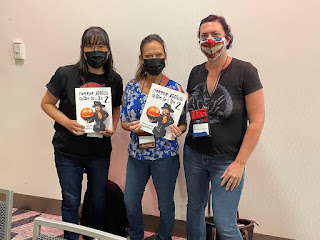
With Lee and Gene at the signing, books handed off!

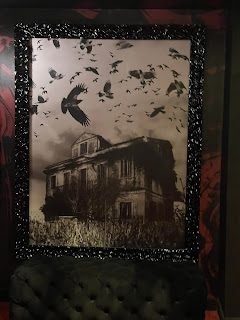
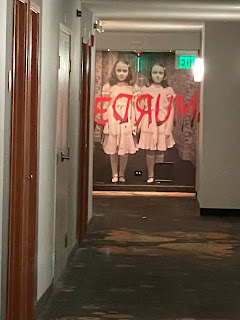
Before I jump into this month's media, which is pretty sparse since I was doing a lot of prep for conferences, I'll leave you with some pictures of the 13th floor of the Curtis, which is horror-themed. In fact, each floor was themed, and I believe there were themed rooms, as well. 

Down one hallway, the girl from Poltergeist

The wallpaper!

On the wall by the elevators

The Grady twins from The Shining down another hallway

Okay, media! These are some of the media I enjoyed in May and late April.

Books 


60 Ways to Die in South America, by Tracy Ashworth


A silly romance with adventure and humorous foibles. A journalist gets sent to South America to cover adventurous travel, something she is definitely not suited for, but money talks. The photographer sent to work with her knows what he's doing, and spends a lot of time saving her from herself on their adventure spree across South America. 

I can sometimes be irritated by the type of main character in these books, because they're a little too stupid for my liking and are frequently constant victims, but I felt like this character held her own a bit better than usual. The romance is sweet and the situation was a unique one.

How Beautiful We Were, by Imbolo Mbue


This book is gorgeous, soulful, and heartbreaking. It traces the line of a family in a small, African village, as they deal with the trouble western civilization (mainly Americans) and their own government and people bring to bear. From people kidnapped as slaves to oil companies destroying the land and the people who must live on it. 

The story is told from different points-of-view, including a collective group called "The Children." It is fascinating how well Mbue weaved their stories together so that there was nothing whatsoever awkward about a group of people speaking as one in those chapters. It's hard for me to explain, but I feel writers should read this for that mechanism alone.

The standout character is Thula, a young woman who starts out as a child at the beginning (her age-mates are "The Children"), watching first her father and then her uncle be destroyed by His Excellency to keep the villagers quiet. But she gets an opportunity to travel to the U.S. and attend a college there. She learns how to fight back for civil rights, and brings her knowledge back to help those villagers still remaining. Her determination makes you want to believe she can overcome her powerful government; the bad decisions of her age-mates, fellow villagers, and patriarchal countrymen; and  and the legal power of an American oil company. Her passion is contagious.

Not a fast read, but definitely worthwhile. Stunning.

Movies


The Lost City


I was all in as soon as I saw Sandra Bullock and a preview that told me this was deeply inspired by Romancing the Stone. It very similar to RtS, but updated, with some important changes. Bullock is always funny, and Radcliffe makes for a great villain. Entertaining, funny, and action packed.

Ritual (Shudder)


This Indonesian horror film was horrifying, but then it threw a bizarre twist that made it all that much more horrifying. The twist is well done, the dread palpable, and the horror...well, horrifying. A man wakes up buried under a pile of dirt. He must find his way to safety and try to find his family, who are also being hunted in the woods. And that's all I can say without giving anything away. Seriously, though, this one will stick with me, both for the abject horror of what came before the twist and the dread that followed it.

Senior Year (Netflix)


This could have failed hard and been stupid, but it was both funny and full of heart. A popular senior gets knocked out during a cheerleading exhibition, going into a coma for twenty years. When she wakes up, she's stuck with the mentality of a senior in high school, even though her body is twenty years older. Determined to get prom queen, which she was destined for before her coma, she goes back to school to finish her senior year and get popular all over again.

Jamie Marks is Dead (Shudder)


A fairly quiet film that follows the death of a boy. A different take on the afterlife and the undead. There's little violence and no real gore.

A fellow student happens across the dead body of Jamie Marks by the river. Jamie was bullied while alive, yet people now come out to grieve his death. But when the girl who found him and a boy who never bullied him start seeing Jamie walking around as if he were living, they each handle it differently.

TV Shows


LOL: Last One Laughing - Canada (Amazon)


A group of well known comedians is locked in a room, armed with humor and plenty of props. The last one to laugh wins. 

Hysterical. I guarantee you're going to recognize some of these comedians. Hosted by Jay Baruchel, you'll have a whole new appreciation for comedians after watching this. Absolutely addictive. I also recommend the Australian version, hosted by Rebel Wilson. There are a ton in other countries, including Germany and Mexico, but I haven't tried watching them yet. Not sure how well humor translates with subtitles. I'm hoping they'll do a U.S. one soon, but if not, I'll be happy with new seasons of Australia and Canada.

Dirk Gently's Holistic Detective Agency (Hulu) (originally BBC America)


This show is so weird! But incredibly twisty and entertaining. Elijah Wood plays a bit of a sad sack, who works at a hotel and gets sucked into the maelstrom that is Dirk Gently, a detective who is constantly mixed up in bizarre things, such as a the mind of a teenage girl being put into a dog, and vice versa. There's time travel, action, danger, and more. And so. much. weirdness.

The Baby (HBO)


This horror comedy is only four episodes in, but it's made a splash, so far. An unlucky woman who has retreated to a private house on the beach at the base of a sheer cliff happens to be having a smoke outside when, first, a woman plummets to her death right in front of her, and then a baby falls into her arms. 

It turns out that everywhere the baby goes, horrible things happen to people. Deadly things. While the first three episodes were darkly comical, the fourth episode had me seething in rage, so maybe a little too relevant to current affairs. I'm looking forward to the return to dark comedy next week. The serious episode was a bit of an origin story.

Hacks


I've only just started then, so I'm two episodes in, but it's a good one. Jean Smart is a famous enough comedian to have a nightly show in Vegas and a ridiculously oversized mansion in the desert. A "cancelled" comedian ends up writing for her, and the show is about their relationship.

I love Jean Smart, and have since "Designing Women," though I much prefer her in her savvier roles. She's in full savvy Jean Smart mode in this one. There are some funny elements and some dramatic elements, and it makes for a good watch.

What have you been watching? Any good shows, movies, or books you'd recommend? Attended any conferences or conventions lately?

May you find your Muse.


Wednesday, March 18, 2020

Insight Into Conference Cancellations

First, thank you to everyone who participated in the blog hop on Friday, the 13th, and everyone who stopped by, and has so far purchased a copy of Bruised Souls & Other Torments! I just got my author copy today, so I was quite nervous, but everything looked great!


I know a lot of you are facing event cancellations, including writing conferences. I volunteer with Pikes Peak Writers, and we had to make the unfortunate choice to cancel this year's Pikes Peak Writers Conference. As one of the people who runs our monthly writing events, I'm also in the middle of scrambling to cancel and postpone events, and to figure out how to run them online for the next month. (If you have suggestions for how to run events where people can talk to each other online, I'd appreciate them! We're looking at Zoom and Facebook Live for different types of events.)

I thought some people might be curious as to why this string of cancellations may put various businesses and non-profits out of business and/or into bankruptcy. We were EXTREMELY lucky in that the event venue for our conference is willing to work with us. Had they shrugged and stuck to the contract, we would have had to claim bankruptcy, and our 501(c)(3) would have been no more. We would not have been able to recover.

Conferences put out a lot of money ahead of the event. Luckily, some of the costs are last minute, so that's money that doesn't go out until just before the event (some the week of) or after the event.

Advance Expenses (this isn't an exhaustive list--it's just to give an idea):
Airfare for faculty (this is a big one)
Registration/software/credit card fees (every transaction costs a certain amount in fees)
Percentage of the upcoming costs due to the hotel/venue in advance (massive chunk)
Bags/badge holders/printing/notebooks/pens/other giveaway shwag
Staff awards
Faculty shwag


Expenses Week of and Week After (again, not exhaustive):
Program printing/sign printing/other printing/printing supplies
Green room supplies
Faculty checks
Decorations for venue/ballroom
Final payment to hotel (includes hotel rooms for staff/faculty, food and beverage)(by far the largest chunk of money goes to this)
Books ordered for onsite bookstore
Consignment fees out to authors

I can't speak for other conferences, but for ours, money brought in for conference fees must cover the conference expenses, overhead for the annual costs of running a non-profit, expenses for monthly programming, etc. So having to refund conference fees to everyone means no money brought in to cover the annual expenses of the organization, on top of conference expenses already paid out and non-refundable. Plane tickets can be used within the next year, but unfortunately, the next conference is more than a year out, so we can't reuse those tickets. Anything paid out ahead of time is a loss.

I also work for a small business, a restaurant. At this time, our governor has shut down bars, restaurants, theaters, and similar businesses, except for takeout, drive-thru, or curbside. Each small business that cannot operate right now still has to pay their rent, utilities, etc. The big concern, of course, is the employees of these places. Most businesses appear to be adapting (as we have), and are providing takeout and curbside, which keeps their employees working and earning money. But bars can't do this, nor can many other types of businesses. If restaurants in your area are staying open, consider supporting local. Corporations have something to fall back on, and they will survive. Small businesses have nothing to keep them going.


We're living through interesting times right now. What it's shown is that humans (most, anyway) are quick to adapt and survive. I hope you're all doing well. If you've had an event canceled, please try to be kind to those responsible for running it. The decision to cancel an event is a hard one, and there are many factors people may not think about when it comes to following through. Bear in mind, also, that writers conferences and other types of conventions are often run by volunteers, so we're all doing this on top of day jobs and other life events, and we're doing so for free.

On a side note, if you have children home from school during this, you might want to ask them if they have friends who are in a bad situation at home and could use a break by coming to your house. Also, it helps if you can check if any of their friends need food or access (aka driving them) to places giving out lunches and breakfasts for those who are accustomed to getting them at school. Check with your elderly neighbors and immuno-compromised friends to see if you can do a grocery run or help with other errands. And if you have other ideas for how to help others, please feel free to leave your ideas in the comments.

Stay safe.

Has an event you were looking forward to been canceled? Has your town shut down yet? Do you know of an online format that might work to have meetings? Any ideas for how to help others during the quarantine?

May you find your Muse.


*Nosmoke Clip Art (dollar signs), clker.com, OCAL
*Hotel Icon Room Service Clip Art, clker.com, OCAL


Monday, May 16, 2016

Writer's Conference Basics, Part I - Overview

As I've mentioned, I attended Pikes Peak Writers Conference in April. I was also staff, faculty, and a volunteer, putting me in a semi-unique position to see a single conference from four different points of view. I also worked in a position that gave me access to the anonymous surveys filled out during and after the conference, which gave me yet more insight into the process, so I thought I'd pass along some tips in a multi-part series told from these different points of view.


Part I will focus on a general overview of conferences, and the people at them.

Conference or Convention?

First, I should define what a conference is. A conference tends to be a professional gathering, intended for writers, not fans (although we're all fans, too). There are workshops (where someone teaches on a specific topic), panels (where several people present and answer questions), and other types of programming and activities, though workshops are the primary focus. There may be pitches, critiques, open mic sessions, and more. You may or may not get food as part of your registration. Often, registration must be in advance, especially if food is involved. These can be anywhere from a day to a week, but are most frequently over a weekend. They usually cost more than conventions, but often involve some sort of food.

A convention is more geared toward fans in many cases, and has a more carefree feel, even if the programming is for writers. There will still be scheduled programming, usually more focused on panels than single instructor workshops, and they may have parallel programming that focuses on something fan related. They will also have sessions that are focused more on fun stuff, such as the tea dueling session at Anomaly Con. Chances are, there will also be people in costume. These usually cost less than formal conferences, but they don't feed you at all.


Attendee, Volunteer, Staff, or Faculty?

Now let's go over the difference between attendees, staff, volunteers, and faculty. Bear in mind that my familiarity is with a writer's conference run by a nonprofit, so not everything I say will be true for all different types of conferences or conventions.

Attendees are the people that have paid to attend (or won some sort of comped conference via a giveaway, auction, scholarship, or some other means.) They go to workshops, but do not have to work in any way. They are there to learn and to network.

Volunteers are attendees who have volunteered to help onsite, but do not take part in advance planning. They will be in positions that allow them to help for brief periods of time without missing much in the way of workshops and programming.

Staff consists of the volunteers running the conference. They hold a position title, though that title is likely not known to attendees or even faculty unless it's someone like the director. Their work starts anywhere from days to months (to years) before the actual event. These are the directors, the registrars, the planners, etc. There are staff members who do not have to do any work in advance, but miss a chunk of the conference due to their jobs. Some staff don't get to attend any workshops, because their jobs are that involved. Staff are not paid (again, at least at the conferences I'm familiar with, which are run by nonprofits.) They may receive a comp toward the conference (a comp is getting a percentage or amount off the price of the conference,) but this is by no means guaranteed.

There is also venue staff. Our conference is held at a Marriott hotel. Their staff are not conference staff, and our staff are not hotel staff. They're paid by the venue, and that's who they represent. They have nothing to do with the actual conference.

Faculty are the speakers running the workshops, sitting on the panels, etc. They're the teachers. They're also the editors, agents, experts, and illustrators. They can be brought in from outside the area, and may also be staff members. Some may be paid, some may not be, depending upon the conference and what or how much they're doing at conference. They are likely getting some sort of comp to conference, whether partial or full, and whether they're being paid or not.

Cost

The cost is all over the place. Conventions will be anywhere from $20 to a couple hundred. Conferences will usually be $100 to above $1000. The longer the conference, and the more food provided, the more expensive the conference.


Both may have optional extra costs. For instance, conventions may offer pictures and/or signed autographs from faculty at an additional charge, or t-shirts. They may have parallel programming with its own cost. Conferences may offer recordings of the workshops or an additional cost to pitch or get a critique. They may also offer extra programming, such as a specific separate track or an extra day of programming, at an additional cost.

You also need to take into account hotel, food, and travel costs. If the conference is local, this isn't an issue. Otherwise, these are necessary costs unless you have an alternate way of handling these, such as a friend who lives nearby. Often, a conference or convention will have a special discounted hotel rate if you let them know you're attending. This will be at a specific convention/conference hotel. Be sure to check the convention/conference website to find out if there are specific discounted hotels or meal plans.

Note: Book your hotel rooms in advance! If you are staying at an event hotel, the rooms may sell out fast. And if you plan on bringing your own food, ask to reserve a room with a refrigerator.

And, of course, books. There will always be books for sale. We all know this is a big cost for writers!


How Do They Work?

I don't want to make this post too long, so I'm going to go over this very basically, and will cover more in the attendee portion.

Registration - Find their website and they will have instructions on registering, (because they want you to attend). Conventions will usually have a fairly short registration form, while a conference will probably have a longer registration form. In addition to your general information, there may be questions about food choices, class choices, merchandise, pitch and critique choices, and more. You will be expected to pay when you register, not at the venue (although many cons have onsite registration available.) There may be payment plans for the more expensive ones. You should get an email confirming your registration.

Check-In - You will have to check in at a registration desk when you get to the event. These are usually clearly marked, but the front desk at the venue can direct you, if not. At that time, you will receive materials like a badge with your name on it, a schedule, meal tickets, appointment cards, and swag. You must have the badge to have access to the programming, so don't lose it! If food or appointments are involved, you will either find the information for that in your badge or in a registration packet (if you were given one.) My advice is to always take a moment to go through the materials you're given at the registration desk to be sure you got everything you should have, and so you can ask questions then and there. Read through the program. There is often important information in there.

Workshops/Panels/Programming - Now you choose what you want to go to! Look through the schedule. If there are workshop descriptions, look through those, too. A title might be misleading, so make sure you've read what the workshop or panel is really about. You'll likely have some session times where there are multiples you want to see, while other session times won't have anything of interest. It's the nature of the beast.

I'll have more information on this in the next post, but this should get you started. Please feel free to ask any general conference or convention questions in the comments, and I'll answer them the best I'm able.

Do you have any questions about conference or convention attendance? Have you attended a con? Have you worked at one? Taught at one? Have any advice of your own? Are there any terms in this post you need defined?

May you find your Muse.

Avatar Costume by Jesse, clker.com
Dollar: Nosmoke by OCAL, clker.com
Books by OCAL, clker.com